
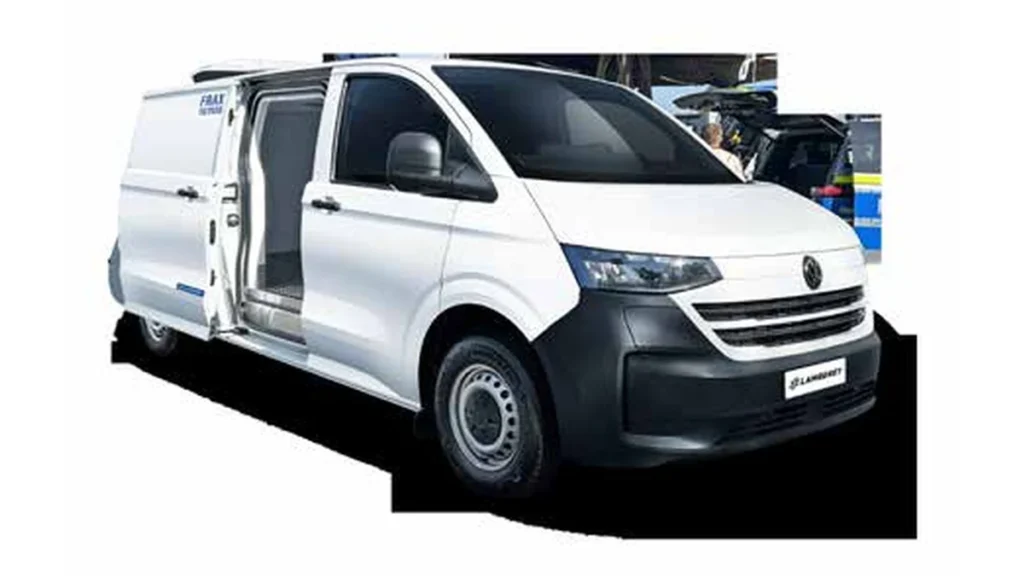
The VW Transporter T7 refrigerated conversion in Lamberet’s 2025 innovations brochure shows why integrated refrigeration is attractive for urban and chilled deliveries. The vehicle is described in L1 and L2 versions with integrated insulation and Kerstner e-CoolJet 106. Three points matter: no additional roof height, usable load space and refrigeration designed for positive temperatures.
What did the VW Transporter T7 refrigerated conversion show at Solutrans 2025?
Solutrans 2025 took place in Lyon from 18 to 22 November 2025. Lamberet’s innovations brochure presented the new Volkswagen Transporter T7 as a refrigerated vehicle with integrated insulation and Kerstner e-CoolJet 106. This matters to Kerstner because the unit demonstrates how refrigeration can be integrated discreetly into modern vans.
The e-CoolJet 106 is intended for chilled delivery applications. The condenser and compressor are integrated close to the vehicle structure rather than conventionally on the roof. The evaporator is integrated into the roof area of the load space. This preserves the vehicle’s external height.
More information on the technology is available in the Kerstner refrigeration unit overview and on the detailed page for e-CoolJet 106. The exhibition itself is documented on the official Solutrans website .
Why does preserving vehicle height matter in daily use?
For urban deliveries, height often determines whether a vehicle can be used without difficulty. Underground car parks, courtyards, low passages, barriers and multi-storey car parks impose limits. A roof unit may exceed them.
Preserving the height makes refrigerated vehicle operation more predictable. This particularly helps store deliveries, catering, meat and delicatessen routes, and deliveries in densely built city centres. Drivers need fewer alternative solutions and dispatchers can plan more stable routes.
| Point | Everyday benefit | Relevance to customers |
|---|---|---|
| Preserved external height | better access to underground car parks and courtyards | fewer restrictions on urban deliveries |
| Integrated evaporator | more usable load space | easier loading of boxes and containers |
| Integration close to the underfloor area | no conventional roof unit | clean vehicle appearance |
| Chilled delivery focus | positive temperatures | suitable for food, catering and retail |
Which applications suit a van of this size?
The VW Transporter T7 sits between small urban vehicles and large panel vans. This class appeals to many businesses: it offers more load space than a compact vehicle while remaining more manoeuvrable than a Sprinter, Crafter or Daily.
Typical uses include multi-stop routes, delicate fresh goods, catering containers, delicatessen products, baked goods requiring refrigeration and regional deliveries. The base vehicle is only one part of the decision: temperature range, door openings, load carriers and payload must suit the application.
The brochure therefore does not make a blanket recommendation for every business. It shows that this vehicle class with integrated Kerstner refrigeration is technically interesting. We determine whether it suits your routes using vehicle data and the operating profile.
What does e-CoolJet 106 mean in this context?
The e-CoolJet 106 is an electric Kerstner refrigeration unit. This does not automatically mean the vehicle itself is battery-electric. The distinction matters because electric refrigeration and battery-electric propulsion are different things.
The VW Transporter T7 in the brochure focuses on integrated refrigeration. What matters to customers is that the system saves space, is integrated close to the vehicle and is intended for chilled goods. The exact specification requires checks of the vehicle version, electrical system, payload and temperature requirements.
Which questions should be answered before choosing the vehicle?
Before a quotation, establish whether the T7 is really the right size. With few stops and small volumes, a more compact vehicle may suffice. For pallets, high payloads or long routes, a larger panel van may be more economical.
The goods also matter. Meat, dairy products, delicatessen products, flowers and catering containers impose different demands on airflow, cleaning and load securing. A brief needs assessment is therefore useful before discussing equipment or price.
This also matters to dealers. Naming only a vehicle model leaves too many questions unanswered. Asking about temperature range, stops, packaging units and access restrictions demonstrates stronger expertise and avoids later corrections.
What does this mean for you?
- You get an example of refrigeration without additional roof height.
- You see why integrated evaporators can help urban deliveries.
- You can compare the T7 class with Vito, Transit Custom and similar models.
- You clearly distinguish electric refrigeration from vehicle propulsion.
- You have a good basis for a specific enquiry to Kerstner.
FAQ
Is the VW Transporter T7 with e-CoolJet 106 an electric vehicle?
Not automatically. e-CoolJet 106 refers to the electric refrigeration unit. Whether the base vehicle is battery-electric, hybrid or conventional must be considered separately.
Is the VW Transporter T7 refrigerated conversion intended for frozen goods?
The brochure describes e-CoolJet 106 in connection with positive-temperature refrigeration. Frozen transport requires a different technical specification to be assessed.
Why is an integrated evaporator useful?
An integrated evaporator saves load space and reduces obtrusive fittings. This makes loading, cleaning and daily use easier.
What information does Kerstner need for an assessment?
The vehicle version, temperature range, goods, stops per route, load space requirements and desired equipment matter. These establish whether the solution fits.
Final call to action
If you are considering a VW Transporter T7 or a comparable class as a refrigerated vehicle, get in touch. The direct contact with our sales team will lead to the appropriate technical assessment.