
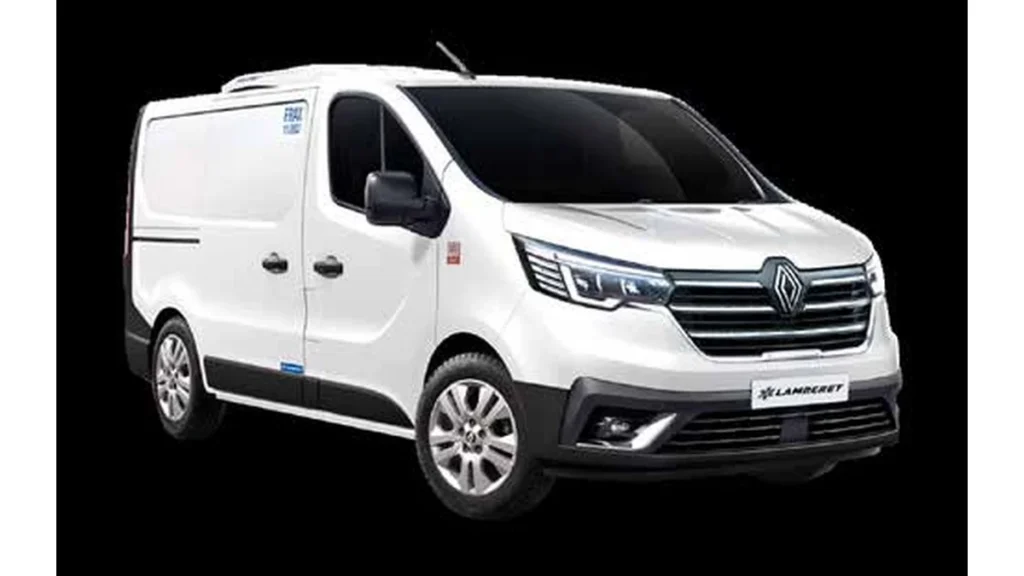
The Renault Trafic CoolJet 103 is one of the Kerstner-related examples in Lamberet’s 2025 innovations brochure. The Trafic L1H1 is described as a compact refrigerated van for urban routes. The key technical feature is the Kerstner CoolJet 103: a monobloc-style, hermetic unit without conventional refrigerant lines in the vehicle body and with an integrated evaporator.
What makes the Renault Trafic with CoolJet 103 attractive?
The Renault Trafic L1H1 is a practical size for many businesses. It is more manoeuvrable than large panel vans but offers more load space than small delivery vehicles. This middle ground can suit urban deliveries, catering, delicatessens or pharmacy logistics.
The brochure describes the Trafic with integrated insulation and a specification relevant to ATP. CoolJet 103 forms a compact unit within the system. According to the brochure, this design reduces maintenance and better preserves usable load space because the evaporator is integrated into the roof area.
For context, CoolJet 103 is Kerstner’s smaller range for compact load volumes. On the website, you can find the product page for CoolJet 103 as well as the general refrigeration unit overview. The exhibition is described on the official Solutrans website .
Why does a monobloc-style refrigeration unit help with service?
In conventional systems, service points often arise where components are mounted separately and connected by pipes. A compact, hermetic design reduces these interfaces. This can simplify maintenance and improve everyday availability.
This is especially important for vehicles making many short trips every day. A failure in this class often directly affects the last mile. Refrigeration capacity alone is then not enough: rapid diagnosis, clear spare parts supply and an uncomplicated conversion also matter.
| Feature | Practical benefit | Typical application |
|---|---|---|
| CoolJet 103 | compact refrigeration for smaller load volumes | urban and local transport |
| Integrated evaporator | more usable space | boxes, crates, delicatessen products |
| Fewer interfaces | easier to maintain | regular routes |
| Trafic L1H1 | manoeuvrable and practical for daily use | city centres and store deliveries |
Which goods suit this vehicle class?
The Renault Trafic L1H1 is no substitute for high-volume vehicles. It is attractive when the amount of goods remains manageable, stops are frequent and the vehicle needs to work well in urban traffic.
Typical goods include delicatessen products, chilled foods, catering supplies, baked goods requiring refrigeration, laboratory or pharmacy goods and smaller chilled deliveries. Frozen transport, multiple compartments or extensive pallet capacity require another solution to be assessed.
The model name alone is not enough. Temperature range, payload, number of door openings, cleaning process and packaging units are decisive. A needs assessment before the quotation is therefore better than a blanket recommendation.
For businesses with several locations, it also matters whether the same solution can later be applied to more vehicles. A single Trafic may be a good starting point. For fleets, though, cleaning, spare parts, driver training and service must remain consistent across vehicles. This standardisation saves time every day.
How does CoolJet 103 differ from larger CoolJet models?
CoolJet 103 is intended for smaller applications. Larger load volumes or more demanding temperature ranges require other ranges. This is where it helps to compare CoolJet 203, CoolJet 206 and e-CoolJet 106.
An oversized unit costs unnecessarily and may be unsuitable in operation. An undersized unit is overwhelmed in summer or with many stops. The right unit always depends on the actual route profile.
Which details speed up the technical assessment?
Brand and model are not enough for a reliable assessment. Kerstner needs the required vehicle version, temperature range, goods and route data. Door openings per route, stationary periods, cleaning method and whether a side sliding door will be used are particularly important.
Loading also matters. Euroboxes, GN containers, pharmacy crates and small roll containers need different interior widths, floors and securing points. Having these details early makes it easier to decide whether a Trafic L1H1 is sufficient or a larger vehicle makes more sense.
Clear documentation also helps service and spare parts support. Unit type, vehicle data and photos speed up later assessment. This applies throughout the vehicle’s service life, not only at purchase.
What does this mean for you?
- You see a compact solution for urban refrigerated transport.
- You can compare Trafic, Expert, Vito and Transporter more effectively.
- You recognise why ease of maintenance matters for small fleets.
- You check early whether positive-temperature refrigeration is sufficient or frozen transport is required.
- You avoid an oversized or undersized refrigeration unit.
FAQ
Is CoolJet 103 intended for large panel vans?
No. CoolJet 103 is mainly attractive for compact load volumes. Large panel vans need more powerful ranges depending on the application.
Is the Renault Trafic L1H1 suitable for frozen goods?
This must be assessed individually. The brochure mainly describes the Trafic as an urban solution for positive-temperature refrigeration.
Why is the integrated evaporator important?
It reduces fittings in the load space and helps preserve usable volume. This makes loading and cleaning easier.
What alternative is there if more volume is needed?
Larger vans such as Sprinter, Crafter, Daily, Ducato or comparable models may then be considered. The suitable refrigeration unit is selected afresh.
Final call to action
If you are planning a Renault Trafic or a comparable class as a refrigerated vehicle, we will assess the application with you. The direct contact with our sales team is the quickest starting point.