Fresh food logistics aligned with HACCP
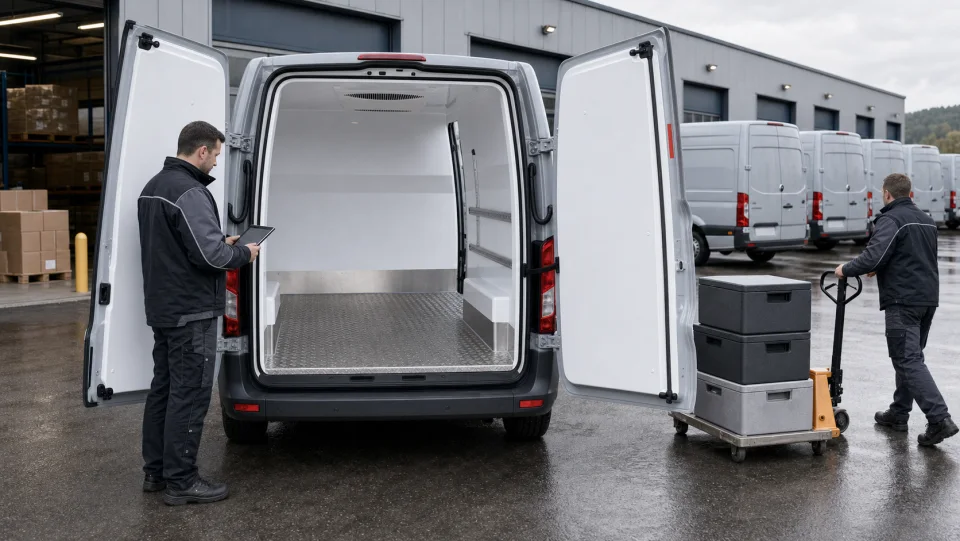
The conversion supports hygienic workflows, easy cleaning and stable temperature control. The operator remains responsible for the business’s HACCP plan.
Explore food retail
Refrigerated vehicles for food retail
Whether for supermarkets, fresh food stores, farm shops, food wholesalers or branch deliveries, Kerstner plans refrigerated vehicles so that temperature control, load volume and daily stops work together.
Quick answers
For food retail, the vehicle model is only part of the picture. Goods, temperature window, route profile, door openings, load compartment, payload and the right combination of interior insulation and refrigeration unit are crucial.
Start an enquiryDecision guide
Food retail needs reliable temperature control, robust interiors and vehicles that remain straightforward to use every day.
The conversion supports hygienic workflows, easy cleaning and stable temperature control. The operator remains responsible for the business’s HACCP plan.
Explore food retailRefrigerated panel vans can often handle regional routes, branch deliveries and urban stops more economically than larger refrigerated trucks.
Open the fleet guideWith frequent door openings, refrigeration capacity, stationary periods, load compartment layout and robust, easy operation matter more than vehicle size alone.
View vehicle examplesTypical challenges
Branch and fresh food delivery routes involve frequent loading and unloading. Every door opening puts temperature control under pressure.
Dairy products, meat, convenience foods, fruit and drinks do not always have the same requirements.
Trolleys, crates, boxes and frequent cleaning demand robust, usable interiors.
Stationary periods, route length, loading windows and vehicle availability must be coordinated.
The Kerstner solution
Kerstner specifies refrigeration and insulation to suit the goods, stops, ambient temperature and driving conditions.
The load compartment, floor, walls, load securing and operation are tailored to crates, trolleys or boxes.
Partitions, multiple compartments, temperature recording and stationary refrigeration are included where they help in everyday operations.
Uniform vehicle standards can be defined for multiple stores or sites.
Examples of suitable vehicles
The following models are examples, not a restriction. Many other van models may be suitable depending on route, volume, payload, powertrain and temperature range.



Recommended refrigeration unit
CoolJet 203 or CoolJet 206, depending on the vehicle, load volume and stop profile. For food retail, refrigeration capacity alone is not enough: insulation, airflow, door openings and ease of use must work together.
Benefits
based on goods, temperature and daily stop profile.
for frequent access, cleaning and regular use.
for crates, boxes, trolleys or customised load securing.
when product groups need to be transported separately.
consistent operation and equipment across multiple sites.
Contacts, spare parts and technical support from Kerstner.
FAQ
Depending on the route, compact chilled goods vehicles, medium-sized vans or larger panel vans may be suitable. Goods, temperature range, load volume, door openings, route duration and payload are decisive.
Many fresh food routes operate above freezing, often around +2 °C to +7 °C. Depending on the goods, other ranges, multiple compartments or frozen goods zones may be appropriate.
Branch deliveries require robust doors, good seals, quick operation, suitable load securing, easy cleaning and a refrigeration system that remains stable through frequent stops.
Yes, if temperature requirements and hygiene are carefully planned. Depending on the product range, partitions, multiple compartments or separate loading areas may be useful.
Electric refrigerated vehicles can be particularly suitable for urban and predictable regional routes. Kerstner assesses range, refrigeration energy demand, stationary periods, payload and charging infrastructure together.
Suitable vehicles have easy-to-clean interiors, temperature control matched to the goods and load space suited to the delivery route profile. Kerstner coordinates the vehicle platform, insulation and refrigeration technology for each project.
Refrigerated panel vans up to 3.5 tonnes can flexibly handle regional routes, frequent stops and smaller loads. For many food businesses, this is more economical than a larger refrigerated truck.
Stable temperature control, robust interiors, suitable payload, secure loads and a load compartment designed for frequent door openings are important.
Next step
Tell us about your goods, temperature range, route profile, stops and preferred vehicle platform. We will assess the right Kerstner solution for your food retail business.