
Refrigerated vehicles for butchers
From slaughterhouse to counter — reliable transport for fresh meat.
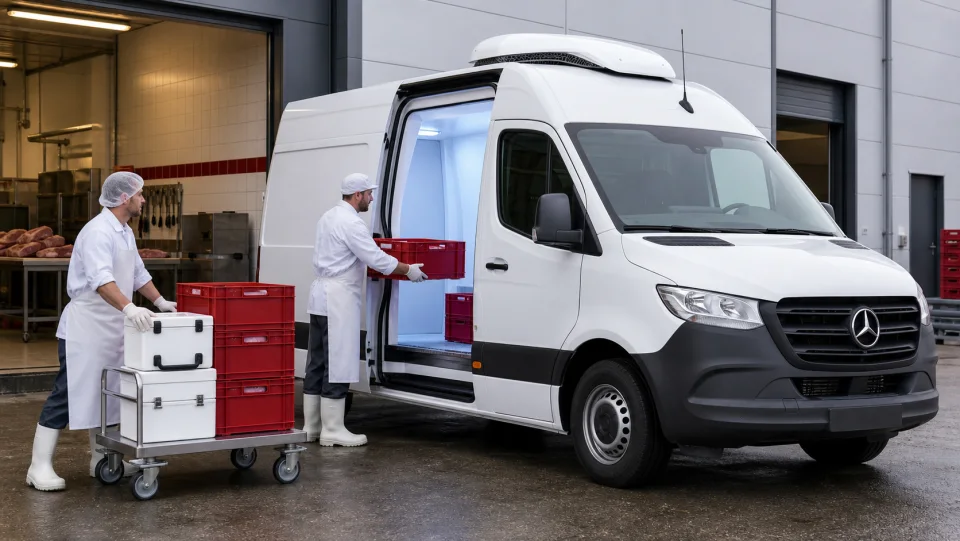
You deliver to branches, commercial kitchens and end customers. Kerstner builds refrigerated vehicles that give your goods the conditions they deserve and the hygiene inspector what they expect to see.
Quick answers
What matters for butchers?
For butchers, the vehicle model is only part of the picture. Goods, temperature window, route profile, door openings, load compartment, payload and the right combination of interior insulation and refrigeration unit are crucial.
Start an enquiry- Industry
- Butchers
- Design
- Consider goods, temperature, load compartment, door openings and payload together
- Refrigeration technology
- Refrigeration unit and interior insulation as a coordinated system
- Vehicle choice
- Suitable models provide guidance and are assessed for each project
Typical challenges
What matters in everyday work.
Doors left open too long.
At every branch, the interior temperature rises and freshness falls. Standard refrigerated vehicles are not built for this.
Cleaning that takes over the day.
Cracks, joints, hard-to-reach corners: the hygiene inspector finds them all.
Refrigeration capacity that drops in city traffic.
Stop-and-go traffic, short routes, frequent door openings. The unit needs to keep up.
Meat hook rails that wobble or start to corrode.
A design that becomes a hygiene problem after three years.
The Kerstner solution
How we build a dependable refrigerated vehicle.
Stainless steel floor with an upturned edge.
Water drains away; cleaning takes minutes, not hours.
Securely bolted stainless steel meat hook rail.
No play and no corrosion, even fully loaded with hanging goods.
Refrigeration capacity matched to the route profile.
We factor in your typical door openings: the refrigeration unit is neither oversized nor undersized.
An interior fit-out suitable for HACCP.
Smooth surfaces, no open joints, food-safe materials.
Examples of suitable vehicles
Suitable vehicle solutions to guide you.
The following models are examples, not a restriction. Many other van models may be suitable depending on route, volume, payload, powertrain and temperature range.
Mercedes-Benz Sprinter
Mercedes-Benz Vito
VW Crafter
VW Caddy
MAN TGE
Fiat Ducato
Iveco Daily
Ford Transit
Opel Movano
Peugeot Boxer

Mercedes-Benz Sprinter
- Application
- Urban and branch deliveries
- Temperature
- +2 °C to +7 °C
- Meat hook rails
- Stainless steel floor
- CoolJet 203

VW Crafter
electric refrigeration
- Application
- Medium-length routes, multiple stops
- Temperature
- +2 °C to +7 °C
- Generous volume
- quiet refrigeration

MAN TGE
electric refrigeration
- Application
- Chilled goods transport
- Temperature
- +2 °C to +7 °C
- Chilled goods refrigeration
- ATP Class A possible
Recommended refrigeration unit
Refrigeration technology to suit your application.
CoolJet 203 for typical butcher delivery routes, e-CoolJet 106 for assessed electric and alternative powertrains. Both handle frequent door openings and short stationary periods, which are crucial for branch deliveries and end-customer routes.
Benefits
Why Kerstner suits this industry.
HACCP-compliant as standard
no expensive optional extras.
Clean in minutes
Stainless steel, upturned edges, smooth surfaces.
Professional-quality meat hook rails
no wobbling, even at full load.
Short door opening times factored in
refrigeration unit remains stable.
Everything from Groß-Rohrheim
Insulation and refrigeration from the same manufacturer, one point of contact.
Service network in Germany and Europe
quick help when operations stop.
FAQ
Frequently asked questions.
Which vehicle suits a butcher with three branches?
For three branches, we typically recommend a Sprinter or Crafter with CoolJet 203 and a meat hook rail set. The precise specification depends on route length, distance between branches and door opening frequency.
Is the vehicle HACCP-compliant?
Yes. A stainless steel floor, smooth interior surfaces, food-safe seals and materials with traceable documentation are standard. We can supply the corresponding data sheets on request.
How long does the conversion take?
Typically 4–8 weeks after the vehicle is made available, depending on variant and equipment. Exact dates are confirmed following your enquiry.
Can my existing vehicle be retrofitted?
Yes, this is often economically worthwhile. We assess its current condition and suggest a suitable solution.
What service is available after delivery?
Maintenance through the Kerstner service network, spare parts directly from Groß-Rohrheim and technical hotline +49 6245 90770-0.
Next step
Ready for your new butcher’s vehicle?
Tell us the number of branches, your typical route length and preferred van model. We will respond within 24 hours with a proposal.