
Refrigerated vehicles for pharmaceutical logistics
Control temperatures reliably. Document processes traceably.
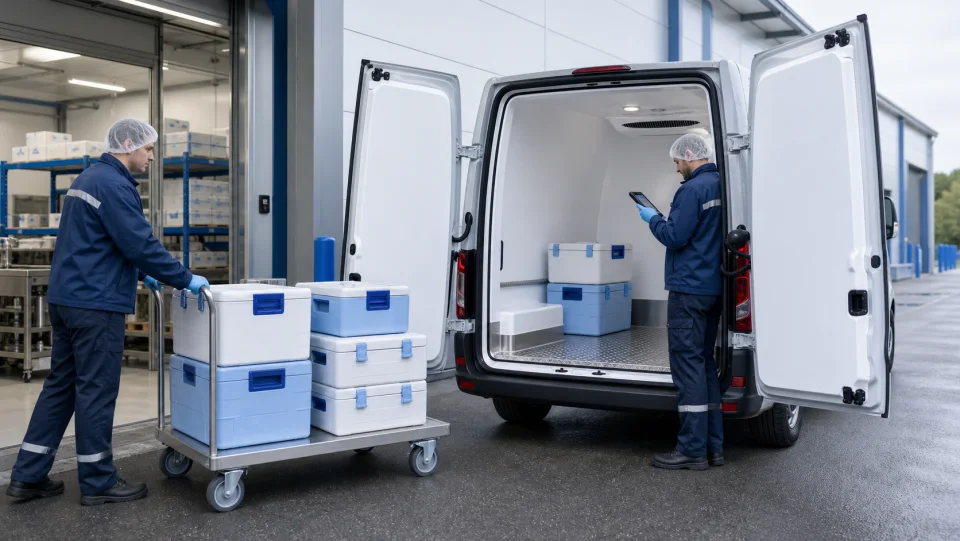
Kerstner develops vehicle solutions suitable for qualification for medicines, vaccines, laboratory samples, medical devices and blood transport. Depending on the application, refrigeration, insulation, temperature monitoring and documentation are designed for -20 °C, +2 to +8 °C or +15 to +25 °C on a project-specific basis.
Quick answers
What matters in pharmaceutical logistics?
For pharmaceutical logistics, the vehicle model is only part of the picture. Goods, temperature window, route profile, door openings, load compartment, payload and the right combination of interior insulation and refrigeration unit are crucial.
Start an enquiry- Industry
- Pharmaceutical logistics
- Design
- Consider goods, temperature, load compartment, door openings and payload together
- Refrigeration technology
- Refrigeration unit and interior insulation as a coordinated system
- Vehicle choice
- Suitable models provide guidance and are assessed for each project
Typical challenges
What matters in everyday work.
Temperature deviations put the product and its compliance evidence at risk.
A dependable solution must consider temperature control and documentation together.
Different products need different temperature windows.
-20 °C, +2 to +8 °C and +15 to +25 °C each impose their own demands on refrigeration, insulation and monitoring.
Qualification needs traceable documentation.
Test conditions, readings, calibration and vehicle configuration must be consistent.
Route profiles and door openings change the demands on the system.
The required capacity reserve is therefore assessed for each project and according to the refrigeration system used.
The Kerstner solution
How we build a dependable refrigerated vehicle.
Designed for GDP-relevant processes.
Vehicle, insulation, refrigeration and monitoring are planned around the defined transport process.
Temperature monitoring to suit your needs.
Optional permanently installed, single-channel or multi-channel systems with USB export or telematics and a customer portal.
Complete documentation package.
Commissioning report, temperature mapping, calibration certificates, installation documentation, operating instructions, maintenance plan and qualification report.
Performance evidence matched to the configuration.
Temperature stability is assessed and documented according to the refrigeration system, vehicle, load and route profile.
Examples of suitable vehicles
Suitable vehicle solutions to guide you.
The following models are examples, not a restriction. Many other van models may be suitable depending on route, volume, payload, powertrain and temperature range.
VW Caddy (German)
Mercedes-Benz Citan (German)
Mercedes-Benz eCitan (German)
Mercedes-Benz Vito (German)
Mercedes-Benz eVito (German)
Mercedes-Benz Sprinter
Mercedes-Benz eSprinter (German)
VW Crafter (German)
Fiat Ducato (German)
Peugeot e-Expert (German)

Mercedes-Benz Sprinter
- Application
- Pharmacy deliveries, hospital routes, laboratory logistics
- Temperature
- -20 °C, +2 to +8 °C or +15 to +25 °C
- Optional temperature monitoring
- Qualification package

VW Crafter (German)
electric refrigeration
- Application
- Pharmaceutical wholesale, high-volume hospital and laboratory routes
- Temperature
- -20 °C, +2 to +8 °C or +15 to +25 °C
- Multiple compartments possible
Mercedes-Benz eVito (German)
electric refrigeration battery-electric
- Application
- Urban pharmacy and hospital logistics
- Temperature
- +2 to +8 °C or +15 to +25 °C
- Compact
- e-CoolJet 106
Recommended refrigeration unit
Refrigeration technology to suit your application.
The refrigeration system is selected to suit the temperature range, load compartment, vehicle platform and route profile. Kerstner can optionally add permanently installed data loggers, telematics and a qualification package.
Benefits
Why Kerstner suits this industry.
Designed to be qualified
for the defined GDP-relevant transport process.
Flexible temperature recording
optional single-channel or multi-channel, with calibration certificate and data export.
Mapping and qualification documents
Mapping by Kerstner, certificate from an external institute.
Project-specific performance evidence
depending on refrigeration system, vehicle configuration and actual route profile.
Several temperature ranges can be planned
-20 °C, +2 to +8 °C or +15 to +25 °C, depending on the application.
Service and recalibration
provided in practice through Kerstner service partners close to the customer.
FAQ
Frequently asked questions.
Is a Kerstner pharmaceutical van automatically GDP-certified?
No. GDP does not assess an individual vehicle in isolation, but the transport process under the operator’s responsibility. Kerstner develops the vehicle solution for GDP-relevant requirements and supports technical qualification with suitable refrigeration, temperature monitoring, mapping and documentation.
How does temperature mapping work?
Kerstner carries out temperature mapping under defined test conditions. Temperature distribution in the load compartment is recorded at several measuring points. The corresponding certificate is issued by an external institute.
Can the data loggers be calibrated?
Yes. Permanently installed single-channel or multi-channel data loggers can be used as an option. Calibration certificates are supplied; subsequent recalibration can be arranged through Kerstner service partners.
How can temperature data be read out?
The readings can be exported to a USB storage device. An optional telematics solution can make temperature data available through the customer portal.
Which documents does the customer receive?
Depending on the project, the customer receives a commissioning report, temperature mapping, calibration certificates, installation documentation, operating instructions, a maintenance plan and a qualification report.
For which applications does Kerstner build temperature-controlled vehicles?
Kerstner develops solutions for medicines, vaccines, laboratory samples, medical devices, pharmacy and hospital logistics, and blood transport. The vehicle and refrigeration technology are always matched to the specific product and route profile.
Next step
Your transport requirements determine the vehicle solution.
Tell us the product, temperature range, route profile, door openings and documentation requirements. We will develop a technically suitable Kerstner solution that can be qualified.